A cautious path for larger contexts

Start with one bounded outcome inside the larger system.

This route is for clarifying context before any broad commitment. It does not claim that one person already covers an enterprise programme or that unverified organizational work exists.

Alignment before commitment

What must align first

A useful project overview describes the operating context, not enterprise buzzwords.

Stakeholders and owners
Who uses the result, who owns product decisions, who reviews implementation, and who approves the first outcome?
Current system
The relevant product surface, repository, integrations, constraints, and dependencies already in place.
Change and review path
How a change is proposed, reviewed, accepted, and coordinated with internal owners.
Documentation and ownership transfer
What the internal team needs to understand, operate, review, or continue after the contribution ends.

Phased entry

A practical first contribution

The goal is to test fit through a useful, bounded contribution before implying broad delivery capacity.

  1. 01

    Map the relevant context

    Identify the named owners, current surface, dependencies, review path, and unanswered questions.

  2. 02

    Select one bounded outcome

    Choose an interface, feature, or integration that can be reviewed without pretending it represents the entire initiative.

  3. 03

    Review, document, and decide

    Review the result with internal owners, document the handover, and use real work to decide whether a next contribution makes sense.

If the first outcome requires capabilities, authority, or a team beyond this fit, that limitation should be visible before commitment.

Relevant evidence

Evidence at the right level

The evidence below supports implementation transparency and bilingual product structure only.

Evidence boundary: These items are not a substitute for a verified enterprise case, a large-team claim, or an organizational performance metric.
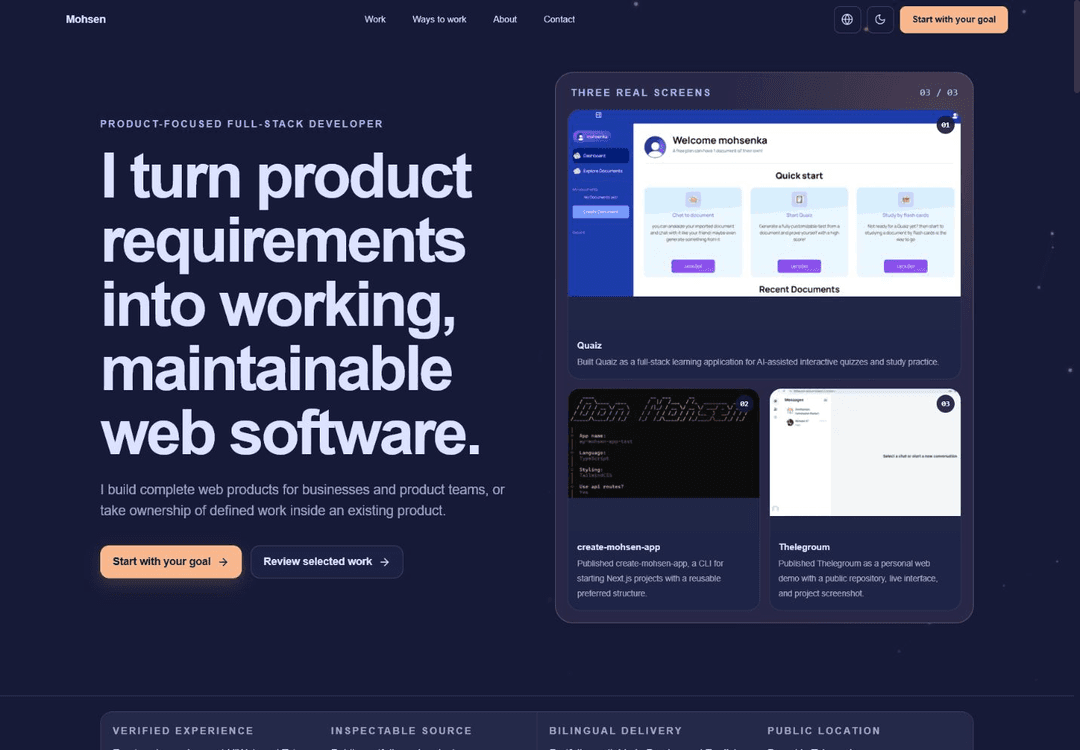
English desktop home page of Mohsen's portfolio

Verified public project

Designed and built this bilingual Next.js portfolio with audience-specific routes, project content, contact flows, and interactive planning tools.

A public Next.js repository with audience-specific routes, project evidence, and structured contact flows.

Open supporting source

Verified site capability

This portfolio has dedicated Persian and English routes with RTL and LTR presentation.

Verified Persian and English routes with RTL and LTR presentation in this portfolio.

Fit boundary

A useful fit—and an honest no

The boundary is part of the offer. It protects both sides from starting with incompatible expectations.

Good fit

  • A web initiative with a named owner and a bounded first outcome
  • A team that can provide product and technical context
  • A phased start that allows fit to be assessed through real work
  • A React or Next.js surface with a clearly owned workstream

Not the best fit

  • A broad transformation promise before the current system is understood
  • A procurement-only conversation with no delivery context
  • A project that needs undisclosed experience to be implied

After the CTA

What happens next

No automatic commitment and no mystery call. The context is reviewed before a next step is proposed.

  1. 1

    Share the overview

    Describe the stakeholders, current system, first useful outcome, dependencies, and decision owners.

  2. 2

    Review fit and gaps

    The context is compared with the public evidence and the limits of a one-person contribution.

  3. 3

    Choose the responsible path

    The answer may be one bounded workstream, a need for a broader team, or no fit at this stage.

Choose one concrete next step

Mohsen
Mohsen
contact@mohsen.info

Tehran, Iran

نسخهٔ فارسی

© 2026 Mohsen.